Basic Definitions
It is an amazing fact that by adjoining the imaginary unit i to the real numbers we obtain a complete number field called `` The Complex Numbers." In this amazing number field every algebraic equation in z with complex coefficients

has a solution. To prove this fact we need Liouville's Theorem, but to get started using complex numbers all we need are the following basic rules.
Rules of Complex Arithmetic
-

- Every complex number has the ``Standard Form''

for some real a and b.
- For real a and b,

-

-

Division
Notice that rules 4 and 5 state that we can't get out of the complex numbers by adding (or subtracting) or multiplying two complex numbers together. What about dividing one complex number by another? Is the result another complex number? Let's ask the question in another way. If you are given four real numbers a,b,c and d, can you find two other real numbers x and y so that

As an exercise in using rules 1 through 5, multiply both sides of the above equation by c + di and then solve for x and y to prove that the answer to our question is yes.( Click on help for a solution.)
OK, so we can divide by c + di if c and d are not both zero. But there is a much easier way to do division.
Notice that

We say that c+di and c-di are complex conjugates. To simplify a complex fraction, multiply the numerator and the denominator by the complex conjugate of the denominator.
Examples of division
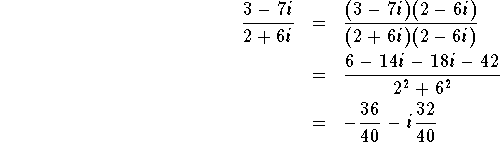


Real and Imaginary Parts
If z= a+bi is a complex number and a and b are real, we say that a is the real part of z and that b is the imaginary part of z and we write

Exercise:
Find  and
and  . (Solution)
Complex Conjugates
If z=a +bi is a complex number with real part a
and imaginary part b, then we denote the complex conjugate of z by
 .
.
Exercise:
Write  in standard form.
Exercise:
Prove that  for any pair of complex numbers and similarly
  .
.
Exercise:
Prove that  for any integer n.
Modulus of a Complex Number
The magnitude or modulus of a complex number z is denoted |z| and defined as

Notice that  . (proof.)
Exercise:
Prove that  . (Solution)


 moving counterclockwise around the circle as
the real number
moving counterclockwise around the circle as
the real number  moves from left to right. Similarly, the point moves
clockwise if
moves from left to right. Similarly, the point moves
clockwise if  or by
or by
 or by
or by  where k is any integer.


 which
this ray makes with the x-axis, the argument of the number z.
All the numbers rz have the same argument. We write
which
this ray makes with the x-axis, the argument of the number z.
All the numbers rz have the same argument. We write

 , a complex number is completely determined by its modulus
and its argument.
, a complex number is completely determined by its modulus
and its argument.
 .
.
 بسم الله الرحمن الرحیم