انتگرال نامعین
اگر  پاد مشتق
  باشد ، آنگاه
  به ازای هر مقدار ثابت
  یک پاد مشتق است.زیرا اگر
  آنگاه:
نکته
اگر  جوابی برای
  باشد ، فرمول
  همه جوابها را به دست میدهد.
انتگرال نامعین
مجموعه همه پاد مشتقهای یک تابع چون را انتگرال نامعین  نسبت به
  مینامند و با
  نشان میدهند.
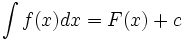
هرگاه فرمول همه پادمشتقهای را به دست دهد، آنرا چنین مشخص میکنیم :
تابع را انتگرال ده انتگرال و را ثابت انتگرالگیری مینامیم. همچنین  نشان میدهد که متغیر انتگرالگیری است.
خواص انتگرال
انتگرال مشتق یک تابع مشتقپذیر  برابر است با به علاوه یک ثابت دلخواه.
 یک ثابت را میتوان از زیر نماد انتگرالگیری بیرون آورد.(توجه شود که عباراتی را که توابعی از متغیر انتگرالگیری اند ، نمیتوان از زیر نماد انتگرالگیری بیرون آورد.)
انتگرال مجموع دو تابع برابر مجموع انتگرالهای آنهاست.این مطلب را میتوان به مجموع هر تعداد متناهی از توابع تعمیم داد.
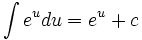
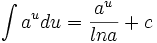
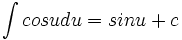
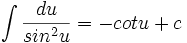
فرمول های انتگرال گیری
 ,
, 
 ,
, 
 ,
, 
 ,
, 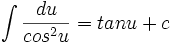
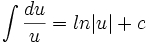
در این دستورها یا متغیر مستقل است و یا تابعی مشتقپذیر از متغیر مستقل دیگری است.
اگر 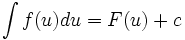 آنگاه
آنگاه 
انتخاب مقدار ثابت انتگرالگیری
در حل یک معادله دیفرانسیل مانند  معمولا به دنبال جواب خاصی هستیم که شرایط عددی از پیش تعیین شده را برآورده سازد.بدین منظور نخست جواب عمومی
  را تعیین میکنیم که همه جوابهای ممکن را به دست میدهد . سپس مقداری از را تعیین میکنیم که جواب خاص مطلوب را به دست دهد.
اگر نقطهای چون  از دامنه
  را در نظر بگیریم و مقدار دلخواه
  را برگزینیم ، میتوان با قرار دادن
  و
و  در معادله و حل آن نسبت به جوابی را یافت که از نقطه
  بگذرد.به این ترتیب داریم
  یا
یا  .
.
خم  خمی است که از میگذرد.
انتگرالگیری به کمک تغییر متغیر
در حل انتگرالها با روش تغییر متغیر ، به جای تابع پیوسته و مشتق پذیر  را قرار می دهیم، یعنی :
بعد از حل ، بر اساس تابع معکوس ، به جای  نسبت به قرار میدهیم . یعنی:
از فرمول فوق به صورت زیر هم میتوان استفاده کرد:
انتگرالگیری به روش جزء به جزء
دستور 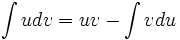 موسوم به انتگرالگیری به روش جزء به جزء است که در آن
  توابعی مشتقپذیر از هستند. اگر انتگرال به صورت حاصلضرب یک تابع لگاریتمی یا یک تابع معکوس مثلثاتی ، در یک چند جمله ای باشد، در این صورت معمولا را تابع لگاریتمی یا تابع معکوس مثلثاتی انتخاب میکنند ولی اگر انتگرال حاصلضرب یک تابع لگاریتمی یا یک تابع نمایی در یک تابع جبری باشد ، معمولا تابع جبری را فرض میکنند.
دید کلی
برای آنکه بتوانیم مساحت شکل مسطح را حساب کنیم واحدی برای مساحت در نظر میگیریم که عبارت است از مساحت مربعی که طول اضلاع آن مساوی واحد میباشد. اگر مثلا اینچ را واحد طول گرفته باشیم واحد مساحت نظیر آن عبارت است از اینچ مربع یعنی مساحت مربعی که طول اضلاع آن یک اینچ میباشد. بر مبنای این تعریف به آسانی میتوان مساحت هر مربع مستطیل را حساب کرد.
مفهوم انتگرال معین
اولین مفهوم اساسی حساب دیفرانسیل و انتگرال عبارت از مفهوم انتگرال میباشد. در این مبحث انتگرال را به عنوان اندازه مساحت سطحی که در زیر منحنی مفروض قرار گرفته است و به صورت حدی در نظر خواهیم گرفت اگر یک تابع مثبت و اتصالی y= داده شده باشد در این صورت مساحتی را در نظر میگیریم که در زیر این منحنی واقع است و از طرف پایین ، قطعه خطی واقع بر محور x ها محدود میشود که ما بین دو نقطه به طولهای a ، b و b>a واقع است و از طرفین به دو خط عمود بر محور xها که از این دو نقطه رسم شوند محدود است. هدف ما آن است که مساحت این سطح را که A نامیده میشود حساب کنیم.
انتگرال معین
نخست به تعریف مساحت ناحیه محصور بین نمودار یک تابع پیوسته نامنفی مانند  و بازه ای از محور
  مانند
مانند  می پردازیم.
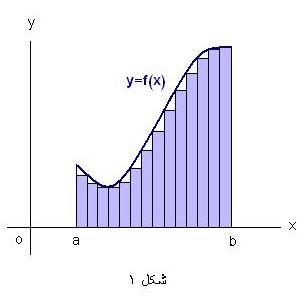
برای این منظور تا آنجا که می توانیم (طبق شکل 1) بخش هرچه بیشتری از این ناحیه را با مستطیل های محاطی قائم پر می کنیم. مجموع مساحت های مستطیل ها تقریبی است از مساحت ناحیه.هرچه تعداد مستطیل ها بیشتر باشد، تقریب بهتری به دست می آید. بنا به تعریف، مساحت این ناحیه، حد مجموع مساحت های مستطیل هاست وقتی که مستطیل ها کوچک و کوچک تر شوند و تعداد آنها به سوی بی نهایت میل کند.
حال اگر به جای مستطیل های محاطی، مستطیل های محیطی (مطابق شکل 2) و یا هر نوع دیگری از مستطیل ها که قاعده پایین آن ها بر محور ها منطبق و قاعده بالای آن ها خم را قطع کنند به کار ببریم، دقیقا" همان حد به دست می آید.
این نکته نیز شایان ذکر است که حد مجموع مساحت های این مستطیل ها نه تنها برای توابع پیوسته نا منفی – که بحثمان را با آن ها آغاز کردیم – بلکه برای هر تابع پیوسته ای وجود دارد.
مجموع انتگرال بالا – مجموع انتگرال پایین
تابع  را در نظر می گیریم که در فاصله تعریف شده است. عبارت
را مجموع انتگرال این تابع گویند که در آن :
مجموع  را مجموع (انتگرال) بالا و
  را مجموع (انتگرال) پایین نامند که در آن :
تابع انتگرال پذیر
حد مجموع انتگرال  وقتی
وقتی  را انتگرال معین تابع در فاصله گویند.
اگر این حد موجود باشد، تابع را در فاصله انتگرال پذیر گویند.
(نکته : هر تابع پیوسته انتگرال پذیر است.)
محاسبه انتگرال معین با استفاده از دستور نیوتن-لایپنیتز
دستور زیر معروف به دستور نیوتن-لایپنیتز است :
که در آن  یک تابع اولیه تابع می باشد یعنی :
مزایای فرمول نیوتن- لایبنیتز
فرمول نیوتن- لابینیتز هنگامیکه یک تابع اولی تابع انتگرال (تابع زیر علامت انتگرال) معلوم باشد یک روش مناسب و عملی برای محاسبه انتگرالهای معین به دست میدهند. در حقیقت انتگرال معین فقط زمانی اهمیت کنونی خود را در ریاضیات کسب کرد که این فرمول توسط نیوتن- لایبنیتز کشف شد. اگر چه پیشینیان (ارشمیدس) از یک عمل مشابهای برای محاسبه انتگرال معین به عنوان حد مجموع انتگرال آگاه بودند، کاربردهای این روش منحصر بود به حالتهای بسیار سادهای که حد مجموع انتگرال میتوانست مستقیما محاسبه شود. فرمول نیوتن- لایبنیتز دامنه کاربردهای انتگرال معین را تا حد زیاد گسترش داد، زیرا ریاضیات یک روش عمومی برای حل مسائل گوناگون خاصی بدست آورد، و بنابراین توانست بطور قابل ملاحظهای حدود کاربردهای انتگرال معین را در صنعت ، مکانیک ، نجوم و غیره توسعه دهد.
تخمین یک انتگرال معین
1. اگر در فاصله  داشته باشیم
  آنگاه :
و بویژه :
2. اگر  کوچکترین و
  بزرگترین مقدار تابع در فاصله باشد، آنگاه :


![$\displaystyle \int \sqrt{\frac{x}{a+x}} dx = \sqrt{x(a+x)} -a\ln \left [ \sqrt{x} + \sqrt{x+a}\right]$](http://integral-table.com/img26.png)

![$\displaystyle \int \sqrt{x(ax+b)} dx = \frac{1}{4a^{3/2}}\left[(2ax + b)\sqrt{ax(ax+b)} -b^2 \ln \left\vert a\sqrt{x} + \sqrt{a(ax+b)} \right\vert \right ]$](http://integral-table.com/img28.png)


 erf
erf where erf


 d
d
![$\displaystyle \int x^n e^{ax} dx = \frac{(-1)^n}{a^{n+1}}\Gamma[1+n,-ax],$](http://integral-table.com/img70.png) where
where  d
d
 erf
erf
 erf
erf

 erf
erf


![$\displaystyle \int \sin^n ax dx = -\frac{1}{a}{\cos ax} \hspace{2mm}{_2F_1}\left[ \frac{1}{2}, \frac{1-n}{2}, \frac{3}{2}, \cos^2 ax \right]$](http://integral-table.com/img83.png)


![$\displaystyle \int \cos^p ax dx = -\frac{1}{a(1+p)}{\cos^{1+p} ax} \times {_2F_1}\left[ \frac{1+p}{2}, \frac{1}{2}, \frac{3+p}{2}, \cos^2 ax \right]$](http://integral-table.com/img87.png)

![$\displaystyle \int \cos ax \sin bx dx = \frac{\cos[(a-b) x]}{2(a-b)} - \frac{\cos[(a+b)x]}{2(a+b)} , a\ne b$](http://integral-table.com/img89.png)
![$\displaystyle \int \sin^2 ax \cos bx dx = -\frac{\sin[(2a-b)x]}{4(2a-b)} + \frac{\sin bx}{2b} - \frac{\sin[(2a+b)x]}{4(2a+b)}$](http://integral-table.com/img90.png)

![$\displaystyle \int \cos^2 ax \sin bx dx = \frac{\cos[(2a-b)x]}{4(2a-b)} - \frac{\cos bx}{2b} - \frac{\cos[(2a+b)x]}{4(2a+b)}$](http://integral-table.com/img92.png)

![$\displaystyle \int \sin^2 ax \cos^2 bx dx = \frac{x}{4} -\frac{\sin 2ax}{8a}- \frac{\sin[2(a-b)x]}{16(a-b)} +\frac{\sin 2bx}{8b}- \frac{\sin[2(a+b)x]}{16(a+b)}$](http://integral-table.com/img94.png)


![$\displaystyle \int x^n \cos x dx = -\frac{1}{2}(i)^{n+1}\left [ \Gamma(n+1, -ix) + (-1)^n \Gamma(n+1, ix)\right]$](http://integral-table.com/img115.png)
![$\displaystyle \int x^n \cos ax dx = \frac{1}{2}(ia)^{1-n}\left [ (-1)^n \Gamma(n+1, -iax) -\Gamma(n+1, ixa)\right]$](http://integral-table.com/img116.png)


![$\displaystyle \int x^n \sin x dx = -\frac{1}{2}(i)^n\left[ \Gamma(n+1, -ix) - (-1)^n\Gamma(n+1, -ix)\right]$](http://integral-table.com/img121.png)


![$\displaystyle \int e^{ax} \tanh bx dx = \begin{cases}\displaystyle{ \frac{ e^{...
...ne b \displaystyle{\frac{e^{ax}-2\tan^{-1}[e^{ax}]}{a} } & a = b \end{cases}$](http://integral-table.com/img137.png)
![$\displaystyle \int \cos ax \cosh bx dx = \frac{1}{a^2 + b^2} \left[ a \sin ax \cosh bx + b \cos ax \sinh bx \right]$](http://integral-table.com/img138.png)
![$\displaystyle \int \cos ax \sinh bx dx = \frac{1}{a^2 + b^2} \left[ b \cos ax \cosh bx + a \sin ax \sinh bx \right]$](http://integral-table.com/img139.png)
![$\displaystyle \int \sin ax \cosh bx dx = \frac{1}{a^2 + b^2} \left[ -a \cos ax \cosh bx + b \sin ax \sinh bx \right]$](http://integral-table.com/img140.png)
![$\displaystyle \int \sin ax \sinh bx dx = \frac{1}{a^2 + b^2} \left[ b \cosh bx \sin ax - a \cos ax \sinh bx \right]$](http://integral-table.com/img141.png)
![$\displaystyle \int \sinh ax \cosh ax dx= \frac{1}{4a}\left[ -2ax + \sinh 2ax \right]$](http://integral-table.com/img142.png)
![$\displaystyle \int \sinh ax \cosh bx dx = \frac{1}{b^2-a^2}\left[ b \cosh bx \sinh ax - a \cosh ax \sinh bx \right]$](http://integral-table.com/img143.png)
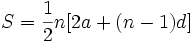
 باشد که در آن d , a عددهای ثابت و مستقل از n هستند، سری را تصاعد حسابی مینامیم. از تعریف
  بدست میآید:

 . پس ، a جمله اول تصاعد حسابی است. بنابراین جملههای دیگر تصاعد حسابی با افزودن مقدار ثابت d به جمله پیش از آن بدست میآید.
 جمله rام تصاعد حسابی باشد، یعنی
  . می خواهیم
  را که با
  نشان داده میشود، حساب کنیم. اکنون ، سری دیگری میسازیم که در آن n جمله اول تصاعد حسابی با ترتیب عکس قرار گرفته باشند سری جدید بصورت زیر است:


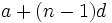 را با l نشان میدهیم. پس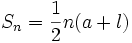
 و جمله nام سری حاصل از ضرب هر جمله در k را با
  نشان میدهیم. بنابراین با تشکیل
  داریم: سری
  و تفاضل مشترک
  است.
است.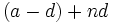 نوشت. چون a-d و d مقدارهای ثابتاند. جمله nام را میتوان به شکل A+nB نوشت که عبارتی خطی از n است. برعکس ، اگر جمله nام یک سری عبارتی خطی از n باشد. آن سری یک تصاعد حسابی است زیرا اگر
  جمله nام یک سری باشد داریم:
  . پس این سری یک تصاعد حسابی با جمله اول A+B و تفاضل مشترک B است.
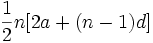 را میتوان به شکل
 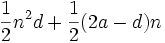 نوشت. که عبارتی درجه دوم از n است. پس مجموع n جمله اول هر تصاعد حسابی را میتوان بشکل
  نوشت که B , A عددهای ثابت و مستقل از n هستند. برعکس ، اگر مجموع n جمله اول یک سری به شکل
  یعنی عبارتی درجه دوم از n بدون جمله ثابت باشد، آن سری یک تصاعد حسابی است.
  قبل از a قرار گیرند یعنی تصاعد حسابی بصورت زیر است:
 را حل کنیم. این معادله برحسب n از درجه دوم است و ممکن است یک یا هر دو ریشه آن منفی باشد. اگر
  مقداری منفی از کمیت n باشد که در این معادله صدق کند داریم:

 کمیتهای مورد نظر باشند واسطه حسابی آنها برابر است با
  . واسطه حسابی دو کمیت b , a که آنها را c مینامیم،
  است. بنابراین ، a و c و b یک تصاعد حسابی تشکیل میدهند زیرا اگر
  داریم:
 . یعنی
  در نتیجه تصاعدهای حسابی بدست آمده چنین است:
 باشد یک دنباله هندسی یا تصاعد هندسی گفته میشود.
  را قدرنسبت تصاعد هندسی مینامیم.
  و
و باشد، دنباله اکیداً صعودی خواهد بود و اگر
 و
و
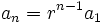 میباشد که واضح نیز به نظر میرسد.
  تا
تا 

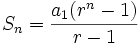
 مجموع جملات دنباله هندسی دیگری با همان عنصر اول ولی
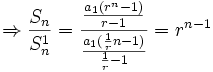
  باشد. رابطه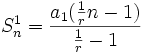
















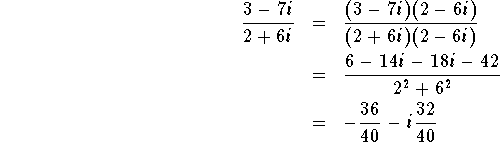


 and
and  .
.  .
.
 in standard form.
 for any pair of complex numbers and similarly
  .
.
 for any integer n.

 .
. .
. 

 moving counterclockwise around the circle as
the real number
moving counterclockwise around the circle as
the real number  moves from left to right. Similarly, the point moves
clockwise if
moves from left to right. Similarly, the point moves
clockwise if  or by
or by
 or by
or by  where k is any integer.


 which
this ray makes with the x-axis, the argument of the number z.
All the numbers rz have the same argument. We write
which
this ray makes with the x-axis, the argument of the number z.
All the numbers rz have the same argument. We write

 , a complex number is completely determined by its modulus
and its argument.
, a complex number is completely determined by its modulus
and its argument.
 .
.
 بسم الله الرحمن الرحیم