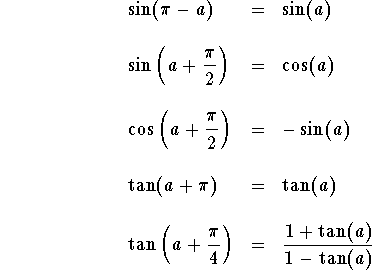
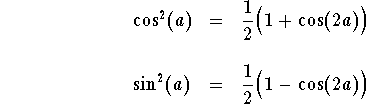
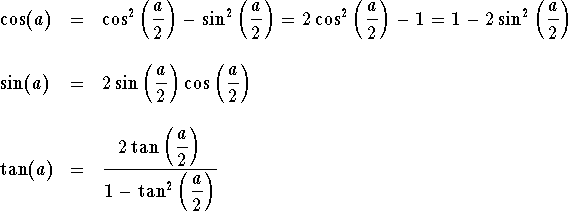
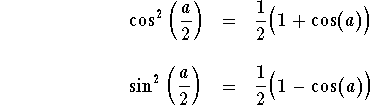
TRIGONOMETRIC FUNCTIONS

that a real number tex2html_wrap_inline453 can be interpreted as the measure of the angle constructed as follows: wrap a piece of string of length tex2html_wrap_inline453 units around the unit circle tex2html_wrap_inline457 (counterclockwise if tex2html_wrap_inline459 , clockwise if tex2html_wrap_inline461 ) with initial point P(1,0) and terminal point Q(x,y). This gives rise to the central angle with vertex O(0,0) and sides through the points P and Q. All six trigonometric functions of tex2html_wrap_inline453 are defined in terms of the coordinates of the point Q(x,y), as follows:

displaymath439

Since Q(x,y) is a point on the unit circle, we know that tex2html_wrap_inline457 . This fact and the definitions of the trigonometric functions give rise to the following fundamental identities:
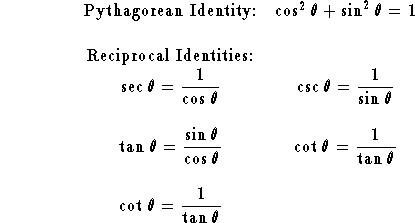
displaymath440

This modern notation for trigonometric functions is due to L. Euler (1748).

More generally, if Q(x,y) is the point where the circle tex2html_wrap_inline483 of radius R is intersected by the angle tex2html_wrap_inline453 , then it follows (from similar triangles) that

displaymath441


Periodic Functions

If an angle tex2html_wrap_inline453 corresponds to a point Q(x,y) on the unit circle, it is not hard to see that the angle tex2html_wrap_inline493 corresponds to the same point Q(x,y), and hence that

  equation74

Moreover, tex2html_wrap_inline497 is the smallest positive angle for which Equations 1 are true for any angle tex2html_wrap_inline453 . In general, we have for all angles tex2html_wrap_inline453 :

  equation78

We call the number tex2html_wrap_inline497 the period of the trigonometric functions tex2html_wrap_inline505 and tex2html_wrap_inline507 , and refer to these functions as being periodic. Both tex2html_wrap_inline509 and tex2html_wrap_inline511 are periodic functions as well, with period tex2html_wrap_inline497 , while tex2html_wrap_inline515 and tex2html_wrap_inline517 are periodic with period tex2html_wrap_inline519 .

EXAMPLE 1 Find the period of the function tex2html_wrap_inline521 .

Solution: The function tex2html_wrap_inline521 runs through a full cycle when the angle 3x runs from 0 to tex2html_wrap_inline497 , or equivalently when x goes from 0 to tex2html_wrap_inline535 . The period of f(x) is then tex2html_wrap_inline535 .

EXERCISE 1 Find the period of the function tex2html_wrap_inline541 .

Solution


Evaluation of Trigonometric functions

Consider the triangle with sides of length tex2html_wrap_inline543 and hypotenuse c>0 as in Figure 1 below:
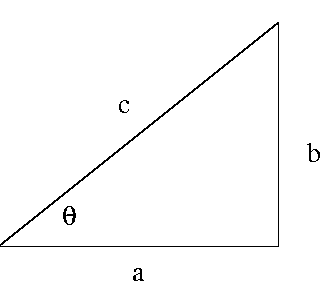
Figure 1

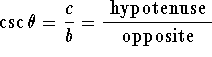
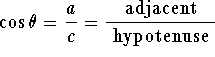
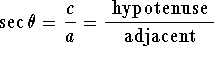
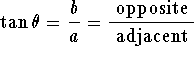
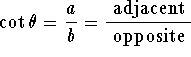
For the angle tex2html_wrap_inline453 pictured in the figure, we see that

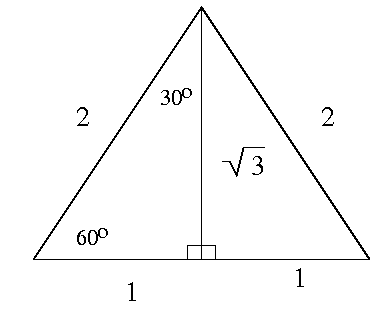
There are a few angles for which all trigonometric functions may be found using the triangles shown in the following Figure 2.

Figure 2

This list may be extended with the use of reference angles (see Example 2 below).

EXAMPLE 1: Find the values of all trigonometric functions of the angle tex2html_wrap_inline549 .

Solution: From Figure 2, we see that the angle of tex2html_wrap_inline551 corresponds to the point tex2html_wrap_inline553 on the unit circle, and so

displaymath443

EXAMPLE 2: Find the values of all trigonometric functions of the angle tex2html_wrap_inline555 .

Solution: Observe that an angle of tex2html_wrap_inline557 is equivalent to 8 whole revolutions (a total of tex2html_wrap_inline559 ) plus tex2html_wrap_inline561 , Hence the angles tex2html_wrap_inline557 and tex2html_wrap_inline561 intersect the unit circle at the same point Q(x,y), and so their trigonometric functions are the same. Furthermore, the angle of tex2html_wrap_inline561 makes an angle of tex2html_wrap_inline551 with respect to the x-axis (in the second quadrant). From this we can see that tex2html_wrap_inline573 and hence that

displaymath444

We call the auxiliary angle of tex2html_wrap_inline551 the reference angle of tex2html_wrap_inline557 .

EXAMPLE 3 Find all trigonometric functions of an angle tex2html_wrap_inline453 in the third quadrant for which tex2html_wrap_inline581 .

Solution: We first construct a point R(x,y) on the terminal side of the angle tex2html_wrap_inline453 , in the third quadrant. If R(x,y) is such a point, then tex2html_wrap_inline589 and we see that we may take x=-5 and R=6. Since tex2html_wrap_inline595 we find that tex2html_wrap_inline597 (the negative signs on x and y are taken so that R(x,y) is a point on the third quadrant, see Figure 3).
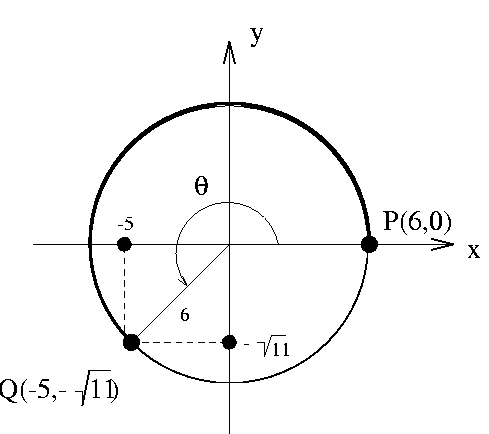
Figure 3

It follows that

displaymath445

Here are some Exercises on the evaluation of trigonometric functions.

EXERCISE 2

(a)
Evaluate tex2html_wrap_inline605 (give the exact answer).

(b)
If tex2html_wrap_inline607 and tex2html_wrap_inline609 , find tex2html_wrap_inline611 (give the exact answer).

Solution

EXERCISE 3 From a 200-foot observation tower on the beach, a man sights a whale in difficulty. The angle of depression of the whale is tex2html_wrap_inline613 . How far is the whale from the shoreline?

Solution

The magic identity

Trigonometry is the art of doing algebra over the circle. So it is a mixture of algebra and geometry. The sine and cosine functions are just the coordinates of a point on the unit circle. This implies the most fundamental formula in trigonometry (which we will call here the magic identity)

displaymath91

where tex2html_wrap_inline93 is any real number (of course tex2html_wrap_inline93 measures an angle).

Example. Show that

displaymath97

Answer. By definitions of the trigonometric functions we have

displaymath99

Hence we have

displaymath101

Using the magic identity we get

displaymath103

This completes our proof.

Remark. the above formula is fundamental in many ways. For example, it is very useful in techniques of integration.

Example. Simplify the expression

displaymath105

Answer. We have by definition of the trigonometric functions

displaymath107

Hence

displaymath109

Using the magic identity we get

displaymath111

Putting stuff together we get

displaymath113

This gives

displaymath115

Using the magic identity we get

displaymath117

Therefore we have

displaymath119

Example. Check that

displaymath121

Answer.

Example. Simplify the expression

displaymath123

Answer.

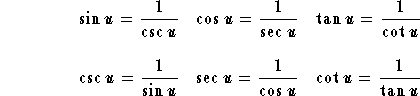
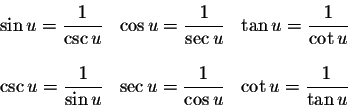
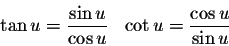
The following identities are very basic to the analysis of trigonometric expressions and functions. These are called Fundamental Identities

Reciprocal identities

displaymath161

Pythagorean Identities

displaymath162

Quotient Identities

displaymath163

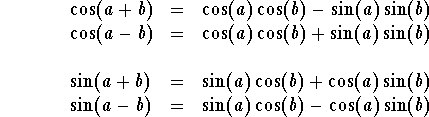
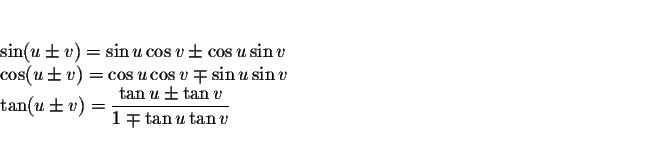
The Addition Formulas

The fundamental identities are very important for the analysis of trigonometric expressions and functions but they are a direct result of the intimate relation between trigonometry and geometry. The power behind the algebraic nature of trigonometry is hidden and can be measured only with the addition formulas

displaymath133

and

displaymath135

Of course, we used the fact that

displaymath137

Example. verify the identity

displaymath139

Answer. We have

displaymath141

which gives

displaymath143

But

displaymath145

and since

displaymath147

and tex2html_wrap_inline149 , we get finally

displaymath151

Remark. In general it is good to check whether the given formula is correct. One way to do that is to substitute some numbers for the variables. For example, if we take a=b = 0, we get

displaymath155

or we may take tex2html_wrap_inline157 . In this case we have

displaymath159

Example. Find the exact value of

displaymath161

Answer. We have

displaymath163

Hence, using the additions formulas for the cosine function we get

displaymath165

Since

displaymath167

we get

displaymath169

Example. Find the exact value for

displaymath171

Answer. We have

displaymath173

Since

displaymath175

we get

displaymath177

Finally we have

displaymath179

Remark. Using the addition formulas, we generate the following identities

displaymath181

More identities may be proved similar to the above ones. The bottom line is to remember the addition formulas and use them whenever needed.

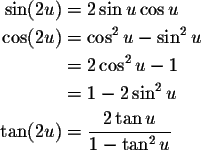
Double-Angle and Half-Angle Formulas

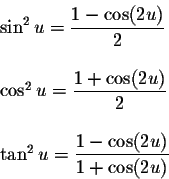
Double-Angle and Half-Angle formulas are very useful. For example, rational functions of sine and cosine wil be very hard to integrate without these formulas. They are as follow

displaymath196

Example. Check the identities

displaymath198

Answer. We will check the first one. the second one is left to the reader as an exercise. We have

displaymath200

Hence

displaymath202

which implies

displaymath204

Many functions involving powers of sine and cosine are hard to integrate. The use of Double-Angle formulas help reduce the degree of difficulty.

Example. Write tex2html_wrap_inline206 as an expression involving the trigonometric functions with their first power.


Answer. We have

displaymath208

Hence

displaymath210

Since tex2html_wrap_inline212 , we get

displaymath214

or

displaymath216

Example. Verify the identity

displaymath218

Answer.We have

displaymath220

Using the Double-Angle formulas we get

displaymath222

Putting stuff together we get

displaymath224

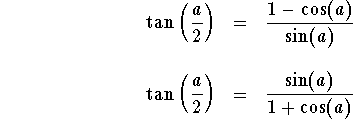
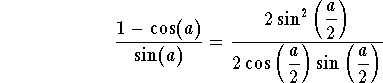
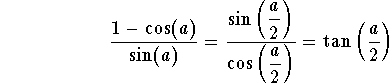
From the Double-Angle formulas, one may generate easily the Half-Angle formulas

displaymath226

In particular, we have

displaymath228

Example. Use the Half-Angle formulas to find

displaymath230

Answer. Set tex2html_wrap_inline232 . Then

displaymath234

Using the above formulas, we get

displaymath236

Since tex2html_wrap_inline238 , then tex2html_wrap_inline240 is a positive number. Therefore, we have

displaymath242

Same arguments lead to

displaymath244

Example. Check the identities

displaymath246

Answer. First note that

displaymath248

which falls from the identity tex2html_wrap_inline250 . So we need to verify only one identity. For example, let us verify that

displaymath252

using the Half-Angle formulas, we get

displaymath254

which reduces to

displaymath256

Table of Trigonometric Identities

Reciprocal identities

displaymath161

Pythagorean Identities

displaymath162

Quotient Identities

displaymath163

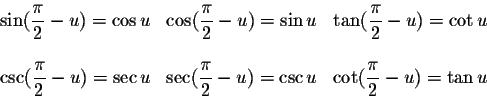
Co-Function Identities

displaymath164

Even-Odd Identities

displaymath165

Sum-Difference Formulas

displaymath166

Double Angle Formulas

align99

Power-Reducing/Half Angle Formulas

displaymath167

Sum-to-Product Formulas

displaymath168

Product-to-Sum Formulas

displaymath169

Download as PDF file

Product and Sum Formulas

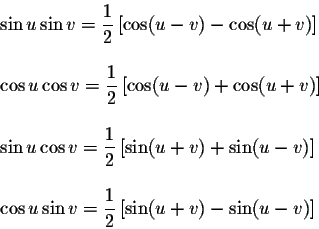
From the Addition Formulas, we derive the following trigonometric formulas (or identities)

displaymath113

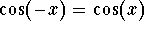
Remark. It is clear that the third formula and the fourth are identical (use the property tex2html_wrap_inline115 to see it).

The above formulas are important whenever need rises to transform the product of sine and cosine into a sum. This is a very useful idea in techniques of integration.

Example. Express the product tex2html_wrap_inline117 as a sum of trigonometric functions.

Answer. We have

displaymath119

which gives

displaymath121

Note that the above formulas may be used to transform a sum into a product via the identities

displaymath123

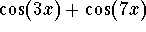
Example. Express tex2html_wrap_inline125 as a product.

Answer. We have

displaymath127

Note that we used tex2html_wrap_inline129 .

Example. Verify the formula

displaymath131

Answer. We have

displaymath133

and

displaymath135

Hence

displaymath137

which clearly implies

displaymath131

Example. Find the real number x such that tex2html_wrap_inline143 and

displaymath145

Answer. Many ways may be used to tackle this problem. Let us use the above formulas. We have

displaymath147

Hence

displaymath149

Since tex2html_wrap_inline143 , the equation tex2html_wrap_inline153 gives tex2html_wrap_inline155 and the equation tex2html_wrap_inline157 gives tex2html_wrap_inline159 . Therefore, the solutions to the equation

displaymath145

are

displaymath163

Example. Verify the identity

displaymath165

Answer. We have

displaymath167

Using the above formulas we get

displaymath169

Hence

displaymath171

which implies

displaymath173

Since tex2html_wrap_inline175 , we get

displaymath177

The Derivatives of Trigonometric Functions

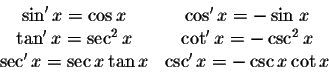
\begin{displaymath}\begin{array}{cc}\sin^\prime x=\cos x&\cos^\prime x=-\cos x\\...
...\prime x=\sec x \tan x&\csc^\prime x=-\csc x \cot x
\end{array}\end{displaymath}

Trigonometric functions are useful in our practical lives in diverse areas such as astronomy, physics, surveying, carpentry etc. How can we find the derivatives of the trigonometric functions?

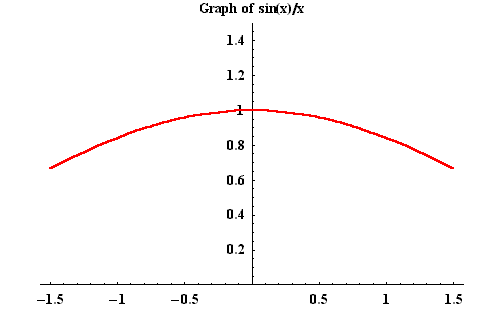
Our starting point is the following limit:

\begin{displaymath}\lim_{x \rightarrow 0} \frac{\sin(x)}{x} = 1\cdot\end{displaymath}

Using the derivative language, this limit means that $\sin'(0) = 1$. This limit may also be used to give a related one which is of equal importance:
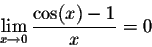
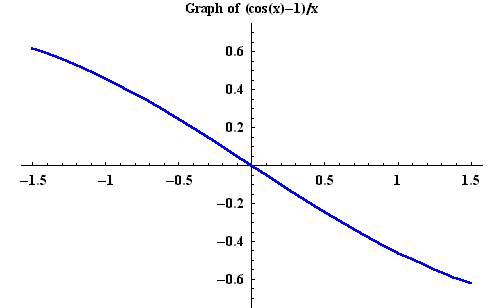
\begin{displaymath}\lim_{x \rightarrow 0} \frac{\cos(x)-1}{x} = 0\end{displaymath}

To see why, it is enough to rewrite the expression involving the cosine as

\begin{displaymath}\frac{\cos(x)-1}{x} = \frac{(\cos(x)-1)(\cos(x) + 1)}{x(\cos(x) + 1)} = \frac{(\cos^2(x)-1)}{x(\cos(x) + 1)}\end{displaymath}

But $\cos^2(x)-1 = -\sin^2(x)$, so we have

\begin{displaymath}\lim_{x \rightarrow 0} \frac{\cos(x)-1}{x} = \lim_{x \rightar...
... \rightarrow 0} x \frac{-\sin^2(x)}{x^2(\cos(x) + 1)} = 0 \cdot\end{displaymath}

This limit equals $\cos'(0)$ and thus $\cos'(0) = 0$.

In fact, we may use these limits to find the derivative of $\sin(x)$ and $\cos(x)$ at any point x=a. Indeed, using the addition formula for the sine function, we have

\begin{displaymath}\sin(a + h) = \sin(a) \cos(h) + \sin(h) \cos(a) \cdot\end{displaymath}

So

\begin{displaymath}\frac{\sin(a + h) - \sin(a)}{h} = \sin(a)\frac{1 - \cos(h)}{h} + \cos(a) \frac{\sin(h)}{h}\end{displaymath}

which implies

\begin{displaymath}\lim_{h \rightarrow 0} \frac{\sin(a + h) - \sin(a)}{h} = \cos(a) \cdot\end{displaymath}

So we have proved that $\sin'(a)$ exists and $\sin'(a) =
\cos(a)$.

Similarly, we obtain that $\cos'(a)$ exists and that $\cos'(a) =
-\sin(a)$.

Since $\tan(x)$, $\cot(x)$, $\sec(x)$, and $\csc(x)$ are all quotients of the functions $\sin(x)$ and $\cos(x)$, we can compute their derivatives with the help of the quotient rule:


\begin{displaymath}\begin{array}{llll}
\displaystyle \frac{d}{dx} (\tan(x)) = \s...
...style \frac{d}{dx} (\csc(x)) = -\csc(x) \cot(x) \\
\end{array}\end{displaymath}

It is quite interesting to see the close relationship between $\tan(x)$ and $\sec(x)$ (and also between $\cot(x)$ and $\csc(x)$).

From the above results we get


\begin{displaymath}\sin''(x) = - \sin(x)\;\;\mbox{and}\;\; \cos''(x) = - \cos(x)\cdot\end{displaymath}

These two results are very useful in solving some differential equations.

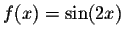
Example 1. Let $f(x) = \sin(2 x)$. Using the double angle formula for the sine function, we can rewrite

\begin{displaymath}\sin(2 x) = 2 \sin(x) \cos(x)\cdot\end{displaymath}

So using the product rule, we get

\begin{displaymath}\frac{d}{dx}\Big(\sin(2x)\Big) = 2 \Big( \cos(x) \cos(x) - \sin(x) \sin(x) \Big) = 2 \Big( \cos^2(x) - \sin^2(x) \Big)\end{displaymath}

which implies, using trigonometric identities,

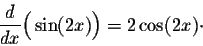
\begin{displaymath}\frac{d}{dx}\Big(\sin(2x)\Big) = 2 \cos(2x)\cdot\end{displaymath}

In fact next we will discuss a formula which gives the above conclusion in an easier way.


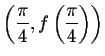
Exercise 1. Find the equations of the tangent line and the normal line to the graph of $f(x) = \sec(x) + \tan(x)$ at the point $\left(\displaystyle \frac{\pi}{4},
f\left(\frac{\pi}{4}\right)\right)$.

Answer.

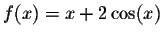
Exercise 2. Find the x-coordinates of all points on the graph of $f(x) = x +2\cos(x)$ in the interval $[0,\pi]$ at which the tangent line is horizontal.

Answer.

The Derivatives of Trigonometric Functions

\begin{displaymath}\begin{array}{cc}\sin^\prime x=\cos x&\cos^\prime x=-\cos x\\...
...\prime x=\sec x \tan x&\csc^\prime x=-\csc x \cot x
\end{array}\end{displaymath}

Trigonometric functions are useful in our practical lives in diverse areas such as astronomy, physics, surveying, carpentry etc. How can we find the derivatives of the trigonometric functions?

Our starting point is the following limit:

\begin{displaymath}\lim_{x \rightarrow 0} \frac{\sin(x)}{x} = 1\cdot\end{displaymath}

Using the derivative language, this limit means that $\sin'(0) = 1$. This limit may also be used to give a related one which is of equal importance:

\begin{displaymath}\lim_{x \rightarrow 0} \frac{\cos(x)-1}{x} = 0\end{displaymath}

To see why, it is enough to rewrite the expression involving the cosine as

\begin{displaymath}\frac{\cos(x)-1}{x} = \frac{(\cos(x)-1)(\cos(x) + 1)}{x(\cos(x) + 1)} = \frac{(\cos^2(x)-1)}{x(\cos(x) + 1)}\end{displaymath}

But $\cos^2(x)-1 = -\sin^2(x)$, so we have

\begin{displaymath}\lim_{x \rightarrow 0} \frac{\cos(x)-1}{x} = \lim_{x \rightar...
... \rightarrow 0} x \frac{-\sin^2(x)}{x^2(\cos(x) + 1)} = 0 \cdot\end{displaymath}

This limit equals $\cos'(0)$ and thus $\cos'(0) = 0$.

In fact, we may use these limits to find the derivative of $\sin(x)$ and $\cos(x)$ at any point x=a. Indeed, using the addition formula for the sine function, we have

\begin{displaymath}\sin(a + h) = \sin(a) \cos(h) + \sin(h) \cos(a) \cdot\end{displaymath}

So

\begin{displaymath}\frac{\sin(a + h) - \sin(a)}{h} = \sin(a)\frac{1 - \cos(h)}{h} + \cos(a) \frac{\sin(h)}{h}\end{displaymath}

which implies

\begin{displaymath}\lim_{h \rightarrow 0} \frac{\sin(a + h) - \sin(a)}{h} = \cos(a) \cdot\end{displaymath}

So we have proved that $\sin'(a)$ exists and $\sin'(a) =
\cos(a)$.

Similarly, we obtain that $\cos'(a)$ exists and that $\cos'(a) =
-\sin(a)$.

Since $\tan(x)$, $\cot(x)$, $\sec(x)$, and $\csc(x)$ are all quotients of the functions $\sin(x)$ and $\cos(x)$, we can compute their derivatives with the help of the quotient rule:


\begin{displaymath}\begin{array}{llll}
\displaystyle \frac{d}{dx} (\tan(x)) = \s...
...style \frac{d}{dx} (\csc(x)) = -\csc(x) \cot(x) \\
\end{array}\end{displaymath}

It is quite interesting to see the close relationship between $\tan(x)$ and $\sec(x)$ (and also between $\cot(x)$ and $\csc(x)$).

From the above results we get


\begin{displaymath}\sin''(x) = - \sin(x)\;\;\mbox{and}\;\; \cos''(x) = - \cos(x)\cdot\end{displaymath}

These two results are very useful in solving some differential equations.

Example 1. Let $f(x) = \sin(2 x)$. Using the double angle formula for the sine function, we can rewrite

\begin{displaymath}\sin(2 x) = 2 \sin(x) \cos(x)\cdot\end{displaymath}

So using the product rule, we get

\begin{displaymath}\frac{d}{dx}\Big(\sin(2x)\Big) = 2 \Big( \cos(x) \cos(x) - \sin(x) \sin(x) \Big) = 2 \Big( \cos^2(x) - \sin^2(x) \Big)\end{displaymath}

which implies, using trigonometric identities,

\begin{displaymath}\frac{d}{dx}\Big(\sin(2x)\Big) = 2 \cos(2x)\cdot\end{displaymath}

In fact next we will discuss a formula which gives the above conclusion in an easier way.


Exercise 1. Find the equations of the tangent line and the normal line to the graph of $f(x) = \sec(x) + \tan(x)$ at the point $\left(\displaystyle \frac{\pi}{4},
f\left(\frac{\pi}{4}\right)\right)$.

Answer.

Exercise 2. Find the x-coordinates of all points on the graph of $f(x) = x +2\cos(x)$ in the interval $[0,\pi]$ at which the tangent line is horizontal.

Answer.

Hyperbolic Functions

The hyperbolic functions enjoy properties similar to the trigonometric functions; their definitions, though, are much more straightforward:

displaymath121

displaymath122

Here are their graphs: the tex2html_wrap_inline125 (pronounce: "kosh") is pictured in red, the tex2html_wrap_inline127 function (rhymes with the "Grinch") is depicted in blue.
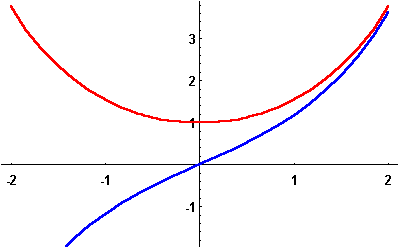

As their trigonometric counterparts, the tex2html_wrap_inline125 function is even, while the tex2html_wrap_inline127 function is odd.

Their most important property is their version of the Pythagorean Theorem.

  • tex2html_wrap_inline133
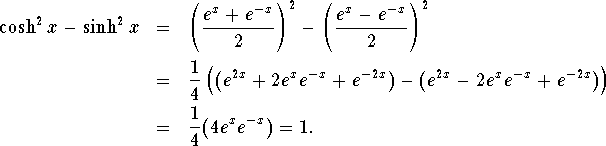
The verification is straightforward:

eqnarray18

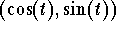
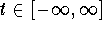
While tex2html_wrap_inline135 , tex2html_wrap_inline137 , parametrizes the unit circle, the hyperbolic functions tex2html_wrap_inline139 , tex2html_wrap_inline141 , parametrize the standard hyperbola tex2html_wrap_inline143 , x>1.

In the picture below, the standard hyperbola is depicted in red, while the point tex2html_wrap_inline139 for various values of the parameter t is pictured in blue.


The other hyperbolic functions are defined the same way, the rest of the trigonometric functions is defined:

eqnarray36

tanh x
coth x
sech x
csch x


For every formula for the trigonometric functions, there is a similar (not necessary identical) formula for the hyperbolic functions:

Let's consider for example the addition formula for the hyperbolic cosine function:

  • tex2html_wrap_inline151
Start with the right side and multiply out:

eqnarray61


Try it yourself!

Prove the addition formula for the hyperbolic sine function:

Show that tex2html_wrap_inline153 .

Here is the answer.

Click here to go to the inverse hyperbolic functions.

Inverse Hyperbolic Functions

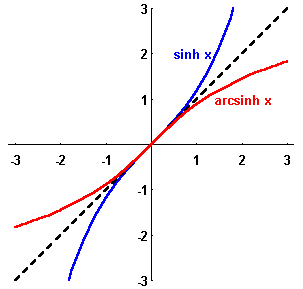
The hyperbolic sine function is a one-to-one function, and thus has an inverse. As usual, we obtain the graph of the inverse hyperbolic sine function tex2html_wrap_inline53 (also denoted by tex2html_wrap_inline55 ) by reflecting the graph of tex2html_wrap_inline57 about the line y=x:

Since tex2html_wrap_inline61 is defined in terms of the exponential function, you should not be surprised that its inverse function can be expressed in terms of the logarithmic function:

Let's set tex2html_wrap_inline63 , and try to solve for x:

eqnarray14

This is a quadratic equation with tex2html_wrap_inline67 instead of x as the variable. y will be considered a constant.

So using the quadratic formula, we obtain

displaymath47

Since tex2html_wrap_inline73 for all x, and since tex2html_wrap_inline77 for all y, we have to discard the solution with the minus sign, so

displaymath48

and consequently

displaymath49

Read that last sentence again slowly!

We have found out that

  • tex2html_wrap_inline81


Try it yourself!

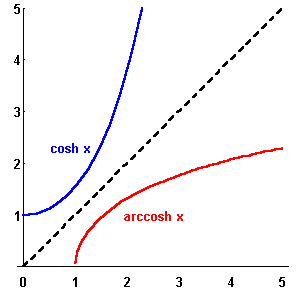
You know what's coming up, don't you? Here's the graph. Note that the hyperbolic cosine function is not one-to-one, so let's restrict the domain to tex2html_wrap_inline83 .

Here it is: Express the inverse hyperbolic cosine functions in terms of the logarithmic function!

Click here to see the answer, and to continue.

Hyperbolic Functions

The hyperbolic functions enjoy properties similar to the trigonometric functions; their definitions, though, are much more straightforward:

displaymath121

displaymath122

Here are their graphs: the tex2html_wrap_inline125 (pronounce: "kosh") is pictured in red, the tex2html_wrap_inline127 function (rhymes with the "Grinch") is depicted in blue.


As their trigonometric counterparts, the tex2html_wrap_inline125 function is even, while the tex2html_wrap_inline127 function is odd.

Their most important property is their version of the Pythagorean Theorem.

  • tex2html_wrap_inline133
The verification is straightforward:

eqnarray18

While tex2html_wrap_inline135 , tex2html_wrap_inline137 , parametrizes the unit circle, the hyperbolic functions tex2html_wrap_inline139 , tex2html_wrap_inline141 , parametrize the standard hyperbola tex2html_wrap_inline143 , x>1.
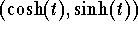
In the picture below, the standard hyperbola is depicted in red, while the point tex2html_wrap_inline139 for various values of the parameter t is pictured in blue.


The other hyperbolic functions are defined the same way, the rest of the trigonometric functions is defined:

eqnarray36

tanh x
coth x
sech x
csch x


For every formula for the trigonometric functions, there is a similar (not necessary identical) formula for the hyperbolic functions:

Let's consider for example the addition formula for the hyperbolic cosine function:

  • tex2html_wrap_inline151
Start with the right side and multiply out:

eqnarray61


Try it yourself!

Prove the addition formula for the hyperbolic sine function:

Show that tex2html_wrap_inline153 .

Here is the answer.

Click here to go to the inverse hyperbolic functions.